%201.svg)

Addressing Hospital Concentration and Rising Consolidation in the United States

Issue Summary
There have been scores of mergers in the trillion-dollar US hospital sector over the past few decades, leading the majority of geographic areas in the US to be dominated by one to three large hospital systems. Approximately 80% of hospital markets in the US are “highly concentrated,” according to criteria set out in the joint US Department of Justice (DOJ)/ Federal Trade Commission (FTC) horizontal merger guidelines (DOJ and FTC 2010). There is a large body of evidence that clearly illustrates that many hospital mergers raise prices and that, more generally, concentrated markets are associated with higher prices and lower clinical quality. Simply put, the high degree of concentration in US hospital markets is increasing health spending and hindering quality in the hospital sector.
Policy Recommendation
We recommend the following five policies:
- Increase the antitrust enforcement budgets at the DOJ and FTC;
- Amend the Federal Trade Commission Act to allow the FTC to take enforcement action against anticompetitive conduct by not-for-profit firms;
- Introduce site-neutral billing in the Medicare program;
- Strengthen antitrust enforcement laws; and
- Introduce reporting requirements for small mergers.
Potential Savings
The US hospital sector accounted for $1.2 trillion of spending in 2018. Hospital spending by the privately insured was approximately $500 billion in 2018. Small steps to increase competition could lead to large savings. In Cooper et al. (2019), for example, the authors estimate that a 10% decrease in hospital market concentration as measured by the Herfindahl-Hirschman Index (HHI) would lower hospital prices by one half of one percent. Likewise, blocking one anticompetitive large health system merger could prevent billions of dollars in increases in health spending. To give a sense of the potential savings, a 1% reduction in hospital spending among the privately insured alone would save $5 billion annually. A 5% reduction would save $25 billion annually (2% of total private health spending).
Background
The US health system in general, and the US hospital sector in particular, are largely market-based. Both public and private payers rely on competition between hospitals to drive quality. Hospitals compete with one another over prices and quality in order to attract commercially insured patients and to be included in insurers’ networks. Each year, hospitals and insurers negotiate over the structure and level of hospital payments. Unfortunately, mergers and acquisitions have led the US hospital sector to become concerningly concentrated, which is ultimately raising health spending and adversely impacting consumers.
The hospital sector is the largest driver of domestic health care spending. In 2018, the US hospital sector accounted for approximately a third of US health spending and 6% of gross domestic product (Centers for Medicare and Medicaid Services 2020), making it one of the largest sectors of the US economy. Moreover, patients must rely on the hospital sector when they are at their most vulnerable: during periods of acute illness, following major injuries, and during childbirth. As a result, having functioning hospital markets in the US is vital to the functioning of the health system.
Unfortunately, there is ample evidence that the markets that underpin the US hospital sector are broken. Over the last 30 years, a wave of hospital mergers in the US has substantially increased market concentration (Gaynor 2020). Our calculations indicate that, at present, more than 80% of hospital markets in the US are “highly concentrated,” based on criteria set out in the DOJ/FTC horizontal merger guidelines (DOJ and FTC 2010). Hospitals are also increasingly buying physician practices—a concerning trend with the potential to further insulate hospitals from competition and harm competition among physician practices as well (Dranove and Ody 2019).
Collectively, the lack of competition in the hospital sector is harming US consumers. As we describe, there is clear evidence that hospital consolidation in the US has raised prices, that hospital concentration can reduce clinical quality, and that when hospitals acquire physician groups, it limits patient choice. In this brief, we highlight the key changes that have occurred in US hospital markets over the last 20 years. We describe the consequences of these changes. We then describe key policy interventions that could improve the functioning of hospital markets in the US and conclude by quantifying the potential savings from these sorts of pro-competitive policies.
Evidence Base
Hospital Mergers
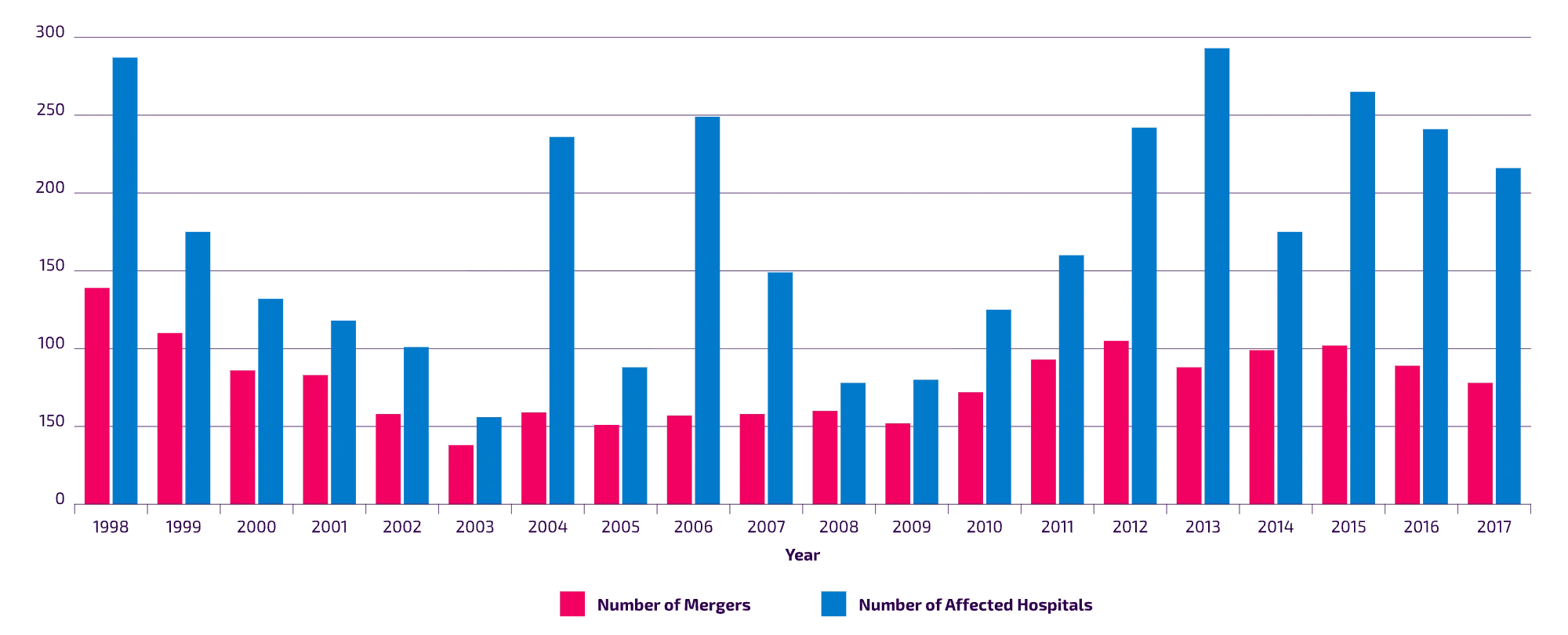
Over the 20 years from 1998 to 2017, as illustrated in Figure 1, there were nearly 1,600 hospital mergers involving thousands of hospitals (Gaynor 2020). As Cooper et al. (2019) note, as a result, during the 2000s, a majority of hospitals have either been directly involved in a merger or have been a neighbor to a merger. Many of the mergers that have occurred have been between close competitors (Cooper et al. 2019, Dafny et al. 2020).
Figure 1: Number of Hospital Mergers, 1998–2017
The academic evidence on the effect of hospital mergers is clear and consistent. The literature suggests that mergers between hospitals that are important alternatives for consumers raise prices. A number of studies have examined individual hospital mergers and found price increases of greater than 20% (e.g., Town and Vistnes 2001, Krishnan 2001, Vita and Sacher 2001, Gaynor and Vogt 2003, Capps et al. 2003, Capps and Dranove 2004, Dafny 2009, Thompson 2011, Tenn 2011, Gowrisankaran et al. 2015). The FTC has conducted a series of merger retrospectives. These analyses have found price increases of 20% to 50% (Haas-Wilson and Garmon 2011, Tenn 2011, Thompson 2011). There has also been work analyzing “cross-market mergers” of hospitals that are not geographically proximate competitors (Dafny, Ho, and Lee 2019, Lewis and Pflum 2017). These studies have observed cross-market merger effects that raised prices between 10% and 17%.
There is significant research evidence that lack of hospital competition compromises the quality of care. Recently, a large retrospective found that hospital mergers did not lead to increases in hospital quality (Dafny et al. 2020). Other research finds that patient health outcomes are significantly worse in more concentrated markets, where hospitals face less potential competition (Kessler and McClellan 2000). Moreover, there is little evidence to indicate that hospital mergers lead to cost savings. A recent study found some evidence of cost efficiencies due to hospital mergers but found them to be less than 5% (e.g., Craig et al. 2018).
Hospital Market Concentration
Mergers and hospital closures have led to large increases in hospital market concentration in the US during the last 20 years. In 2017, the average hospital HHI—a measure of market concentration—was 5,092. It is notable that the DOJ and FTC view markets with an HHI over 2,500 as highly concentrated (DOJ and FTC 2010).1 According to our calculations, approximately 80% of hospital markets in the US have an HHI above 2,500.
There is a large body of literature assessing the relationship between hospital concentration, provider prices, hospital/insurer contract structure, and provider quality. Cooper et al. (2019), for example, find that hospital prices are higher in more concentrated markets. Cooper et al. (2019) also find that, for hospitals in more concentrated markets, prices paid are generally a percentage of the charges billed rather than based on more prospective payment models that can drive efficiency. Perhaps most worryingly, Kessler and McClellan (2000) study the relationship between concentration and quality for Medicare beneficiaries (where reimbursements are regulated). They find that risk-adjusted one-year mortality for heart attack patients is substantially higher in more concentrated hospital markets.
Vertical Integration between Hospitals and Physicians
There has been a steady increase in vertical integration between hospitals and physicians in the US. For example, from 2002 to 2008, Baker et al. (2014) estimate that the share of physician practices in the US owned by hospitals more than doubled. There is a growing body of literature illustrating that physicians within hospital-owned practices are more likely to refer their patients for hospital-based care (Cooper et al. 2019, Baker et al. 2016, Brot-Goldberg and de Vaan 2018). This has the potential to decrease patient choice, decrease the competitive pressure facing hospitals, and raise provider prices. Indeed, Cooper et al. (2019) find that patients referred for imaging studies receive significantly higher-priced MRI scans when they are referred by a vertically integrated physician. In addition, Capps, Dranove, and Ody (2018) find that hospital acquisitions of physician practices led to significant increases in prices for physician services. In effect, when hospitals buy physician practices, it has the effect of limiting patients’ choice sets, further insulating hospitals from competition, and harming competition among physician practices.
Policy Recommendation
There are five concrete policy steps that can be taken to expose hospitals to more competition. Each recommendation, if adopted, could result in increased consumer choice and decreased health spending.
Recommendation 1—Increase Funding for the Antitrust Enforcement Agencies: The federal antitrust agencies (the Antitrust Division of the DOJ and the FTC) need more resources. From 2010 to 2016, the number of mergers reported to the federal government increased by over 57%, while inflation-adjusted funding for the enforcement agencies fell by over 12% (Gaynor 2020).
If we expect the antitrust enforcement agencies to do more in health care without reducing their efforts in the rest of the economy, then they will need more resources. Unsurprisingly, given that enforcement budgets have not increased, the number of enforcement actions has stayed relatively constant, while mergers have risen dramatically. Increasing the DOJ/FTC enforcement budget is one of the most effective things we can do to strengthen antitrust enforcement in health care.
The scale of funding increases necessary is small relative to the potential benefit to consumers. Elsewhere, one of us has advocated for increasing funding for federal antitrust enforcement by $157 million annually (Gaynor 2020). This type of investment would raise the DOJ and FTC merger enforcement budget by 33% (Gaynor 2020).
Recommendation 2—Amend the Federal Trade Commission Act to Allow the FTC to Take Enforcement Action against Anticompetitive Conduct by Not-for-Profit Firms: At present, the FTC is not authorized to take enforcement action against anticompetitive behavior by nonprofit firms (Gaynor 2020). This is problematic because the majority of hospitals in the US are nonprofit (American Hospital Association 2020). Removing this restriction on the FTC’s enforcement abilities would enable it to target a wider range of conduct that is harming consumer welfare.
Recommendation 3—Introduce Site-Neutral Billing in the Medicare Program: Medicare payment policies have inadvertently led hospitals to acquire physician practices (Dranove et al. 2019). In an effort to cover hospitals’ costs for delivering care, the Medicare program gave higher reimbursements to care delivered in hospitals than for the same care delivered in physician offices. This led hospitals to acquire physician practices. Dranove and Ody (2019) estimate that in cardiology, these higher reimbursements led to a 20% increase in vertical integration.
Recommendation 4—Strengthen Antitrust Enforcement Laws: Another important way to increase competition among hospitals is to enact legislation that strengthens existing antitrust laws (Baer et al. 2020). For instance, legislation could change the standard required to show competitive harm or shift the burden of proof to defendants. Current standards require plaintiffs to show “likely harm to competition” (DOJ and FTC 2010). This is a fairly exacting standard, particularly as administered by the courts, and the DOJ and FTC often have trouble meeting it (and sometimes choose not to bring some cases at all). Amending the standard to require that plaintiffs demonstrate “appreciable risk to competition” would still require substantial evidence to win a case but would strengthen the agencies’ hand in enforcement. In addition, if plaintiffs show evidence to support a presumption of harm to competition, then the burden of proof should shift to defendants—they bear the responsibility of rebutting those claims. This contrasts with the status quo, in which plaintiffs typically bear the burden of establishing harms to competition. Reform in this area is also one of the most effective things that can be done to strengthen antitrust enforcement in health care (and in general).
Recommendation 5—Introduce Reporting Requirements for Small Mergers and Acquisitions: All mergers should have reporting requirements. At present, deals under $50 million do not have reporting requirements (15 US Code § 18a). However, this means that many of the transactions in which hospitals acquire physician groups escape antitrust scrutiny. The antitrust agencies should be empowered to create a streamlined reporting process for smaller transactions. Requiring parties in small transactions to report in a simple, streamlined way will enable the agencies to track the many small transactions in health care involving physician practices (both horizontal and vertical) that at present are not reported.
Potential Savings
The US hospital sector accounted for $1.2 trillion of spending in 2018. Hospital spending by the privately insured was approximately $500 billion in 2018 (Center for Medicare and Medicaid Services 2018). Small steps to increase competition could lead to large savings. In Cooper et al. (2019), for example, the authors estimate that a 10% decrease in hospital HHI would lower hospital prices by half a percent. Likewise, blocking one large health system merger could prevent billions of dollars in increases in health spending. To give a sense of the potential savings, a 1% reduction in hospital spending among the privately insured alone would save $5 billion annually. A 5% reduction would save $25 billion annually (2% of total private health spending).
Addendum
This addendum was prepared by the Health Care Affordability Lab at Yale.
Since this brief's publication, new research has reinforced that mergers of hospitals that are viewed as competitors can raise prices. Both Brot et al. (2024b) and Brand et al. (2023) look at hundreds of hospital mergers in the U.S. in the 2010s and find that prices increase by 5% or more after mergers of hospitals that were previously competing for patients. Brand et al. find the largest price increases among transactions where the merging hospitals are close substitutes for one another and where local insurance markets are less concentrated.
There is also an emerging body of work on so-called “cross-market” or “cross-geography” transactions, which involve mergers of hospitals that patients do not necessarily view as substitutes. Dafny, Ho, and Lee (2019), Lewis and Pflum (2017), and Dranove, Vatter, and Kim (2026) all find that some mergers involving parties that are not viewed as traditional substitutes can lead to price increases. Dafny, Ho, and Lee (2019) propose a theory, validated by Dranove, Vatter, and Kim (2026), that when common employers have workers receiving care at both hospitals, these mergers can raise prices by lessening competition.
When hospital prices rise following mergers, the consequences ripple beyond the health sector into local labor markets. Insurers pass those higher prices on to employers in the form of higher premiums. Because most Americans under 65 obtain health coverage through an employer, this functions, in practice, as a tax on labor, with employers across industries responding to higher costs by cutting jobs (Brot et al. 2024b). As employment goes down, so does federal tax revenue.
Recent work also demonstrates that federal antitrust enforcers did not take action to block many mergers that could have been predicted in advance to raise prices by lessening competition. Between 2002 and 2020, there were 1,164 mergers among general acute care hospitals. Applying the same tools regulators use to identify deals likely to weaken competition, researchers found that 238 of them (20%) could have been flagged as likely to harm competition. While those mergers did turn out to raise prices, the Federal Trade Commission (FTC) acted against only 13 of them (Brot et al. 2024a).
A large portion of the underenforcement of federal antitrust laws during the 2000s and 2010s stems from underfunding of the DOJ and FTC. More recently, there is evidence of staffing challenges at the agencies. Between Fiscal Year (FY) 2022 and FY 2026, the DOJ Antitrust Division's budget grew from $193 million to $245 million (DOJ 2025, DOJ 2026). However, staffing has declined from 910 to 776 positions between FY 2024 and FY 2026 (DOJ 2026), raising concern about the agency's enforcement capacity.
The FTC has seen budget cuts, with Congress enacting an FY 2026 budget of $383.6 million—a $42.1 million decrease compared to FY 2025 (FTC 2026). This continued to reverse years of growth that brought the FTC's budget to a peak of $430 million in FY 2023 (FTC CFO 2026). Staffing has also fallen: as of May 2025, the agency had declined from 1,315 to 1,221 personnel (Ferguson 2025). Increasing DOJ and FTC funding remains essential to improving competition in the hospital sector, and evidence from Brot et al. (2024a, 2024b) suggests that FTC enforcement actions against hospital mergers, because they stop job losses that reduce tax revenue, are cost-effective for the federal government.
With federal legislative action stalled, at least 15 states have enacted health care transaction notification requirements, giving state regulators a line of sight into deals that fall below federal reporting thresholds.



More Briefs
$12-$24B
Expanding Site-Neutral Payments in Medicare and Addressing Anticompetitive Vertical Integration of Physicians
